







Blog
Shoe Rack Buying Guide: How Many Pairs, What Height, and What Material Actually Works in a Pakistani Home

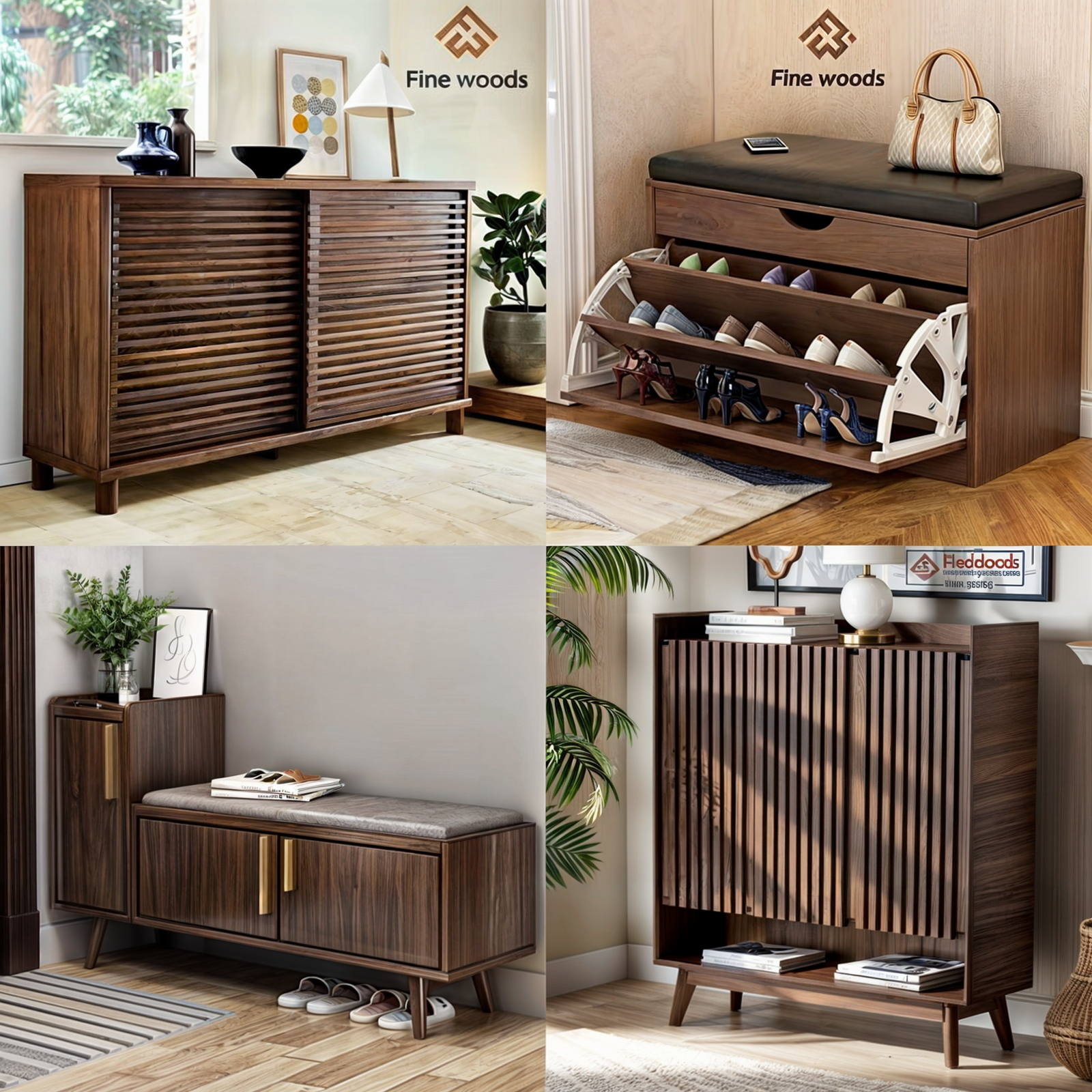
Every single Pakistani home, without exception, has had this exact moment at least once. Eid morning, or a wedding function, or just a regular Sunday when half the family drops by unannounced — and within twenty minutes there are fourteen pairs of shoes scattered across the entrance, nobody can find their own chappal on the way out, and someone’s inevitably standing there in socks looking mildly betrayed. It’s such a common scene that most people just accept it as normal, without realizing the actual fix is a shoe rack sized and placed properly in the first place — which almost nobody thinks through before buying one.
Shoe racks get treated as an afterthought purchase in most furniture shopping — something picked up last, usually undersized, usually wherever it happens to fit rather than where it actually works best. That’s worth fixing, because in a culture where shoes come off at the door as a matter of routine, the entryway storage isn’t a minor convenience item. It’s one of the most-used pieces of furniture in the entire house.
Why this matters more here than almost anywhere else
In most Pakistani households, shoes stay outside the living space — it’s such an ingrained habit that guests do it automatically without being asked. That means the entryway isn’t just where shoes get parked temporarily; it’s functioning as daily overflow storage for every member of the household, plus whoever happens to be visiting on any given day.
And households here tend to be larger than the nuclear-family assumption most furniture is originally designed around. Pakistan’s 2023 census put the average household size at just over six people, and joint and extended family living remains extremely common, especially outside the biggest cities. A shoe rack sized for “a family of four,” which is what a lot of generic imported designs assume, runs out of space fast in a home where grandparents, parents, and kids are all living under one roof, plus regular guests on top of that.
Then there’s the climate side of it. Streets in most Pakistani cities are dusty for a large part of the year, and during monsoon season, shoes coming in from outside are often genuinely wet or muddy, not just dusty. That combination — high shoe turnover, more household members, and shoes that are frequently damp or dirty when they come off — makes the entryway one of the harder pieces of furniture to get right, and one where the wrong choice shows its flaws faster than almost anywhere else in the house.
Figuring out how many pairs you actually need space for
Most people guess at this, and most people guess low. A more reliable way to plan it: count the adults in the household and multiply by three to four pairs each — that typically covers everyday shoes, one or two formal pairs, and something seasonal, like closed shoes for winter and sandals for summer. Add roughly two pairs per child, since kids tend to go through fewer distinct pairs but grow out of them faster, meaning old and new sizes often sit side by side for a while. Then add a guest allowance on top — even a conservative estimate of four to six extra pairs makes a real difference in a household that regularly has visitors, which describes most Pakistani homes at some point during any given week.
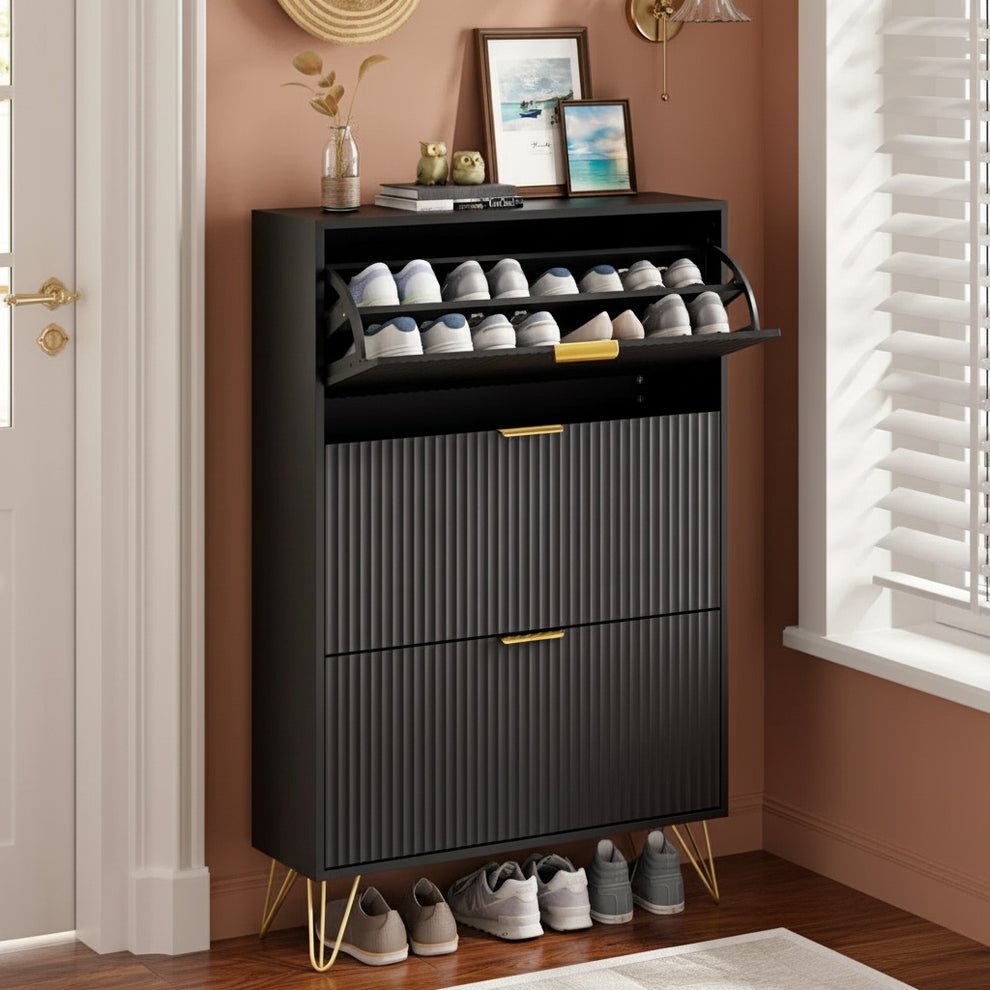
Run that math for a household of six or seven with regular guests, and the number lands well above what a compact, showroom-style shoe rack is built to hold. This is usually the actual reason a shoe rack “fills up too fast” within months of buying it — not that the household owns an unusual number of shoes, but that the rack was sized for a smaller, more nuclear household structure than what it’s actually serving.
The different types, and where each one actually fits
Open shelf racks are the most common and the most affordable, with shoes sitting on visible tiers. They’re easy to access and easy to see what’s there, but they offer no protection from dust, and in a closed entryway they can look cluttered fast, especially with a large household’s worth of shoes on display.
Closed cabinet-style racks, with doors, keep everything out of sight and, more importantly, keep dust and street grime contained rather than settling across the entryway. This matters more in Pakistan than in a lot of other climates, simply because of how much dust actually blows in through an open door on a typical day. The tradeoff is airflow — a fully sealed cabinet without any ventilation can trap moisture and odor, particularly with shoes that came in wet during monsoon season, so ventilated designs or slightly gapped doors work better here than a completely airtight cabinet.
Wall-mounted vertical racks are worth considering specifically for smaller entryways — increasingly common in newer flats and townhouses where floor space right at the door is limited. Mounting off the floor also keeps shoes clear of any water that pools near the entrance during heavy rain, which is a small but genuinely useful advantage during monsoon months.
Bench-style racks with a seat solve a problem most people don’t think about until they don’t have it — somewhere to actually sit while putting on or taking off shoes, rather than balancing on one foot in the doorway. They’re particularly practical for households with elderly members or small kids, both of whom benefit from not having to bend or balance.
Shoe cabinets combined with a mirror are popular for a reason beyond aesthetics — a last mirror check before leaving the house is a genuinely common habit, and combining the two functions saves entryway space that a separate mirror and shoe rack would otherwise both need.
Corner shoe racks are worth a specific mention for smaller entryways or L-shaped hallways, since they make use of a space most other furniture can’t fit into. They tend to hold less than a full bench or cabinet design, but for compact flats where every square foot of entryway is contested, using an otherwise wasted corner is often a better trade-off than squeezing an oversized rack into a walkway.
Getting the height and shelf spacing right
This is where a lot of otherwise good-looking shoe racks fall short in daily use. Standard sneakers and everyday shoes need roughly 6 to 7 inches of shelf clearance, but heeled shoes and boots need closer to 8 to 10 inches, and if the household includes traditional footwear like khussas or kolhapuris, those tend to be flatter but wider than standard shoes, which changes the shelf depth needed more than the height. A rack with uniform, narrow shelving throughout often ends up with heels and boots stored sideways or stacked awkwardly, which is a fast way to damage them.
It’s worth thinking about adjustable shelving for this reason — racks where shelf height can be changed handle a mixed household of sneakers, heels, sandals, and kids’ shoes far better than a fixed-shelf design built around one shoe type.
Overall height matters too, particularly for wall-mounted or tall cabinet-style racks — measure the actual entryway wall space before ordering, including door swing clearance, since a rack that looks reasonably sized in a showroom can end up blocking a door or narrowing a hallway once it’s actually installed.
Material — this is where moisture resistance matters most in the whole house
If there’s one piece of furniture in a Pakistani home where material choice really shows its consequences, it’s the shoe rack. Shoes routinely come in wet, muddy, or damp, especially during monsoon season, which means the entryway furniture deals with more direct moisture exposure than almost anything else you’ll buy. We’ve covered how Sheesham and MDF each handle Pakistan’s humidity in more detail in an earlier post, but the short version for shoe racks specifically: whatever material is used, it needs a solid moisture-resistant finish or sealing, because this particular piece of furniture is essentially guaranteed to get wet at some point, unlike a bedroom set or dining table.
Closed cabinets with a properly sealed base are worth the small extra cost here, since the base shelf is the part most exposed to whatever moisture or mud comes off shoes directly. An open rack in a humid coastal city, made from unsealed board, is one of the fastest pieces of furniture in the house to show water damage, purely because of how it’s used every single day.
Where it actually goes, not just how it looks
Placement matters as much as the rack itself. It needs to sit close enough to the entrance that shoes actually get put there instead of left on the floor near the door out of pure convenience — if it’s tucked away in a corner that requires extra steps, most households will default to leaving shoes wherever they land instead. At the same time, it shouldn’t block the door’s swing radius or narrow a hallway that guests need to pass through, which is a surprisingly common mistake with taller or deeper cabinet-style racks bought without measuring the space first.
If the entryway is genuinely tight on space, a slim wall-mounted design or a narrower vertical cabinet usually works better than trying to force a wide bench-style rack into a space it wasn’t sized for.
Mistakes worth avoiding
Buying based on current shoe count rather than household size and guest frequency, which is why so many racks feel undersized within the first year. Choosing a fully sealed, non-ventilated cabinet without accounting for odor and moisture buildup, especially with school-age kids’ shoes or monsoon-season dampness. Skipping the measurement step and assuming a showroom-sized rack will fit the actual entryway. And treating shoe rack material the same as furniture elsewhere in the house, when it’s genuinely one of the few pieces that needs above-average moisture resistance simply because of what it’s exposed to daily.
Keeping it fresh once it’s in use
Even a well-built shoe rack needs a little upkeep to actually stay pleasant long-term, and this is another area where Pakistan’s climate makes a real difference. During monsoon months especially, it’s worth wiping down shelves every couple of weeks rather than waiting until there’s a visible problem, since trapped moisture in a closed cabinet can lead to a musty smell or, in worse cases, mildew on the shelf surface — something that happens quietly and is much easier to prevent than to fix later. A small pouch of activated charcoal or baking soda tucked into a closed cabinet is a simple, low-cost way to manage odor between cleanings, and it’s worth doing from day one rather than only after the smell becomes noticeable.
For households with school-age kids, it’s also worth thinking about rounded edges and stable, well-anchored shelving, particularly for bench-style racks that double as a seat — a wobbly shelf holding weight every morning during the rush to get to school is more of a hazard than it sounds like on paper.
A shoe rack that actually works long-term in a Pakistani household usually needs to be a size or two bigger than instinct suggests, built with real ventilation if it’s a closed design, and finished with moisture resistance in mind rather than treated like any other piece of furniture in the house. Get those three things right, and it stops being the thing that overflows within a few months and actually becomes the entryway solution it was supposed to be from the start.
If you’re not sure what size or configuration makes sense for your entryway and household, it’s worth having that conversation directly with whoever’s building it — at Finewoods, shoe racks can be custom-sized and finished to match your actual entryway and household needs, rather than picking from a fixed set of showroom dimensions that may or may not fit.